Graphic: Labwor Technologies
I build software in Kampala and Gulu for Ugandan customers, so I have a professional interest in describing this country’s technology position accurately rather than optimistically. Optimism is cheap at conferences and expensive in production. What follows is my reading of where we actually are, with the numbers I could verify and none that I could not.
Mobile money is the platform, and everything else is an application
If you want to understand Ugandan technology, start here and not with startups.
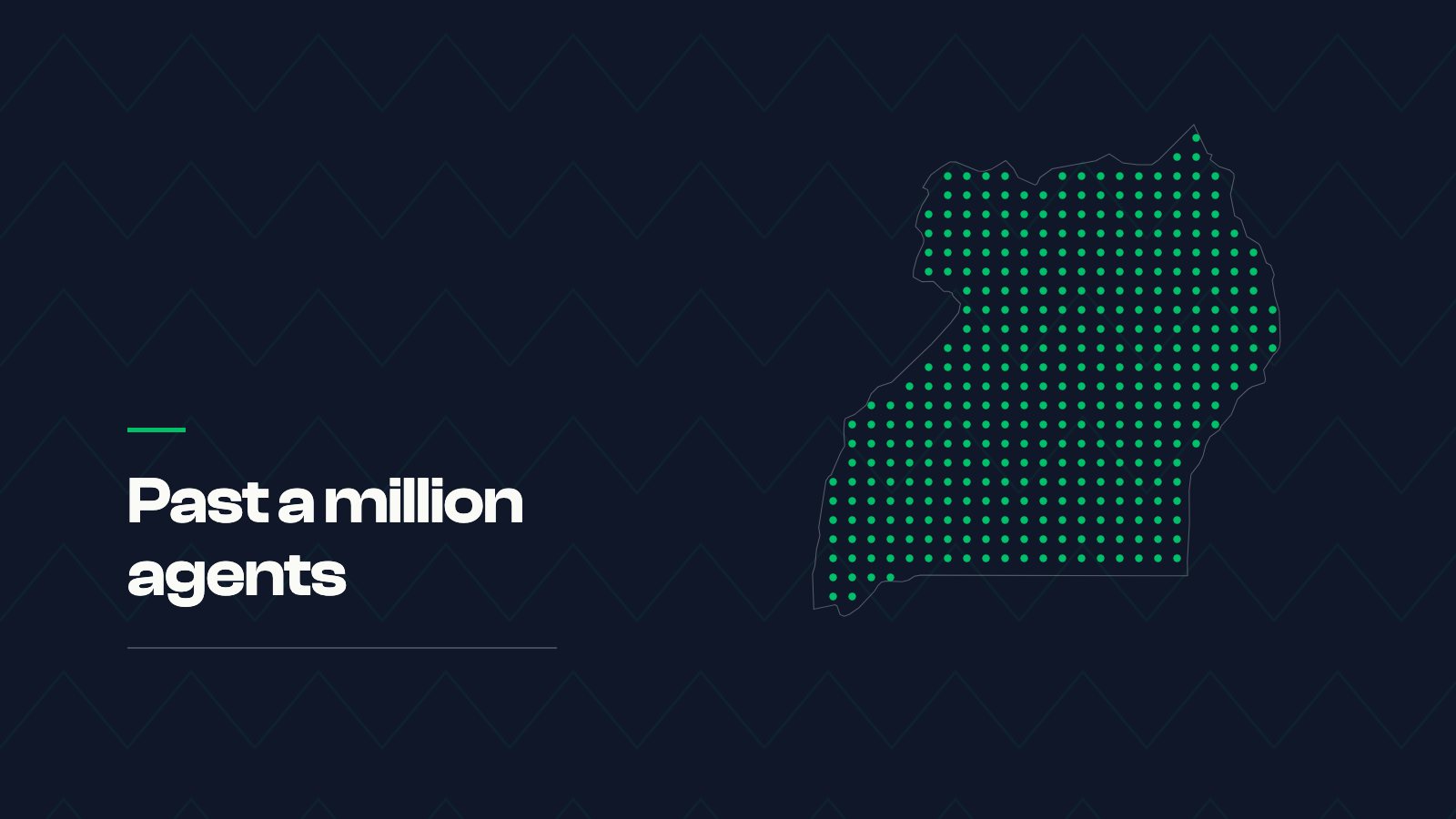
According to the Bank of Uganda’s integrated annual report for the year to 30 June 2025, the value of electronic money transactions in Uganda rose by 28.6 percent to 326.3 trillion shillings, up from 253.7 trillion the year before. Volumes rose 20.6 percent, from 7 billion transactions to 8.4 billion. By the end of June 2025 there were eighteen licensed electronic money issuers and 1,016,914 registered agents, up 27 percent from 775,294 a year earlier.
That last figure is the one I would put on a wall. Uganda has more than a million mobile money agents. There is no other distribution network in this country of comparable reach, public or private.

A Kampala street, with the telecom operators on every hoarding. Photo: Prince Beguin, Unsplash.
The Uganda Communications Commission’s market performance report for April to June 2026, which takes its mobile money figures from the Bank of Uganda, puts active mobile money subscriptions at 37.8 million and records 2.55 billion transactions in that single quarter, up from 2.37 billion in the previous one.
For anyone building here, the practical consequence is simple and it is not about technology at all. The payment path is not a feature you add near launch. It is the first thing to get right, because it is the only part of the stack your customer already trusts completely. Every product I have built for a Ugandan audience, from an online store for a Gulu clothing shop to a barber booking app, lives or dies on whether money moves the way people already expect it to move.
Connection is cheap by the gigabyte and expensive by the month
Here the picture gets less flattering.
The same UCC report for April to June 2026 counts 49 million active mobile subscriptions, up from 47.5 million in the previous quarter, but only 19.7 million active mobile internet subscriptions, up from 17.9 million. Smartphones number 20.5 million. Average data use stands at 3.7 gigabytes per user per month, with an average monthly data bill of 10,841 shillings and average total monthly spend on mobile services of 15,349 shillings. Sector revenue for the quarter reached a record 1.73 trillion shillings.
DataReportal’s Digital 2026 Uganda report counted 11.4 million internet users at the end of 2025, or 22 percent of the population, alongside 40.9 million cellular connections.

Lines, devices and people, counted separately. Sources: Uganda Communications Commission, April to June 2026; DataReportal Digital 2026.
Put those together and the gap is the story. There are almost as many active mobile subscriptions as there are Ugandans, although plenty of people carry two SIM cards. Fewer than half of those subscriptions are on the internet at all. And a NetCredit affordability study published in August 2026 ranked Uganda 103rd of 112 countries surveyed, finding that an average fixed-line broadband package costs 34.53 percent of average local monthly income.
So the frequently repeated claim that Ugandan data is among the cheapest in Africa by the gigabyte can be true at the same time as connectivity being unaffordable, because affordability is a fraction and we keep only looking at the numerator. A person who buys 200 shillings of data at a time is not connected in any sense a product designer should rely on. They are connected in bursts, at moments of their choosing, and your application needs to work in between.
This is why Scholaris, the school management system I am building for a first pilot in Nwoya District, runs on a local database on the school’s own machine and does not synchronise to a cloud at all in its first version. That is not a limitation I apologise for. It is the requirement.
Power is the constraint outsiders underestimate
World Bank development indicators put Ugandan access to electricity at 51.5 percent of the population in 2023, and 76.4 percent in urban areas. Roughly half the country, therefore, is outside the conversation about digital services in the most literal way possible.
For the half that is connected, reliability has recently gone backwards. The Uganda Electricity Distribution Company took over distribution from Umeme on 1 April 2025 at the end of a twenty-year concession. On 3 August 2026, the company’s acting managing director Jocelyn Rwakakooko told Parliament’s Public Accounts Committee that the frequency of outages had almost doubled since the transition, and that the average time to restore supply had risen from about twelve hours to nearly twenty.
Twenty hours is not a blackout, it is a working day and a night. Any architecture that assumes a server room stays up, or that a clerk in a district office can complete a task in one session, is an architecture designed for a different country. I have come to treat power as a first-class design input in the same way I treat authentication.
Government digitisation is real, and it is early
There is a genuine state programme here, and it is neither the triumph the press releases claim nor the vapour the cynics assume.
NITA-U launched a five-year strategic plan in June 2026 covering the 2025/26 to 2029/30 financial years. Its own baselines are the most useful public admission of where things stand: 9.2 percent of Ugandans actively use e-government services, and the plan aims for 40 percent by the end of 2029/30. Thirty-seven percent of ministries, departments and agencies are connected to the UGHub integration platform, targeted to reach 73 percent. Public satisfaction with e-government services sits at 22.2 percent, targeted at 35 percent. National Data Centre utilisation is at 70 percent, heading for 83. NITA-U says UGHub currently serves over 150 entities.

NITA-U’s own baselines and 2029/30 targets, from its five-year strategic plan published in June 2026.
I read that document as broadly credible precisely because the baselines are unflattering. An agency claiming 9.2 percent usage is not exaggerating.
Two other rails are further along and matter more to a small company than any portal does.
The first is identity. The National Identification and Registration Authority ran a parish-level mass enrolment and renewal exercise from 27 May 2025 to 8 February 2026 after an extension. Its exercise-closure statement, announced 9 February 2026, reported around 35 million people registered, 6,416,958 first-time enrolments, and 28,571,893 records migrated into a new system. The figure of 13,365,388 identity cards renewed is the interim count NIRA gave in a December 2025 update, since the closure statement re-bucketed renewals together with changes of particulars and first-time IDs rather than publishing a clean final renewals-only number. Whatever one thinks of the timing relative to the January general election, a functioning national identity register is the precondition for almost every serious digital service, financial or clinical.
The second is procurement. The Public Procurement and Disposal of Public Assets Authority had onboarded thirty-six government entities onto the electronic government procurement system as of its March 2025 review, and Phase II began rolling out in July 2026 with a central supplier platform and mandatory electronic bid submission. For a small Ugandan firm hoping to bid for public work, that is the single change most likely to matter, because a paper tender process quietly favours whoever can afford to physically stand in the queue.
The talent question is not a supply question
The Uganda Bureau of Statistics Labour Market Survey 2025, whose findings were presented in April 2026, puts unemployment among fifteen to twenty-four year olds at 17.9 percent, and reports that about 4 million young people in that bracket, 42.6 percent of them, are not in employment, education or training.
And yet, as somebody trying to build a company, I cannot easily find a person I can hand a module to.
Both things are true, and the reconciliation is uncomfortable. Uganda produces graduates in quantity. It does not produce maintainers, because becoming one requires two or three years inside a real codebase with somebody senior correcting you, and there are very few places in this country where that apprenticeship exists. The training programmes that get announced solve the first six months of the problem, which was never the hard part. I received my own second year of practice from an international open source community that had no obligation to teach me anything, and I am conscious of how narrow that door was.
What is real, and what is not
Real: the mobile money rails, and the agent network behind them. The national identity register. Electronic procurement, now that Phase II has started moving. Offline-capable products, because the constraints demand them. And, more than most people here realise, Sunbird AI’s Sunflower models, released in October 2025, which are open-weight Ugandan language models that outperform the large commercial systems on most of the thirty-one Ugandan languages they were evaluated on. That is world-class work done in Kampala, and it is more consequential than any hub announcement of the past decade.
Not real: the Silicon Valley comparisons. Counting innovation hubs as though they were output. Strategy documents with no procurement behind them. And, I would add, any product plan that assumes stable power and continuous connectivity, which describes a surprising number of pitch decks I have been shown.
The most striking fact of 2026, though, was not on any of these dashboards. On the evening of 13 January the UCC ordered internet service providers to suspend public internet access, and it stayed down through the general election until 18 January, with social media restrictions continuing after. Five days. Every payment and every clinic sync stopped, along with every business that had moved itself online.
I do not raise that to make a political point. I raise it because it belongs in an honest technical assessment. In Uganda, the network is a policy instrument as well as an engineering one, and a system that cannot survive a week without it is a system that has not been designed for the country it runs in. That is the real status quo, and building well here starts with accepting it rather than waiting for it to change.
Sources and further reading
- Market Performance Report, Q2 2026
- Digital 2026: Uganda
- Which countries have the most affordable internet
- Access to electricity, Uganda
- Five-Year Strategic Plan, FY2025/26-2029/30
- Press release on mass enrolment and renewal exercise
- Press statement on e-GP system performance and reporting
- Labour Market Survey 2025 findings
- Sunflower: A New Approach To Expanding Coverage of African Languages in Large Language Models
- Temporary suspension of public internet access and mobile services
- Uganda's electronic money transactions grow by 28.6% in 12 months to UGX 326.3 trillion
Frequently asked questions
What is the real state of Uganda's technology sector in 2026?
Mobile money is the real platform: Uganda has more than a million active agents, a distribution network with no equivalent, public or private. Internet use lags badly behind mobile phone ownership because data is unaffordable relative to income, and electricity reaches only about half the country. Government digitisation is genuinely underway, national identity, procurement, a strategic plan, but the baselines it starts from are still low. None of it is Silicon Valley, and none of it is vapour either.
How reliable is electricity supply in Uganda for running a digital service?
Only around half the population has access to electricity at all, and even where power exists, reliability has recently gone backwards. After the Uganda Electricity Distribution Company took over from Umeme in April 2025, the frequency of outages nearly doubled, and the acting managing director told Parliament in August 2026 that average restoration time had risen from about twelve hours to nearly twenty. A system that assumes constant power is designed for a different country.
How many people has Uganda registered under its national identification exercise?
By NIRA's exercise-closure statement of 9 February 2026, around 35 million people had been registered, including 6,416,958 first-time enrolments, with 28,571,893 records migrated into the new system. An earlier figure of 13,365,388 renewed identity cards comes from a December 2025 update and should be read as an interim count, since the closure statement re-bucketed renewals together with other categories rather than publishing a final renewals-only number.