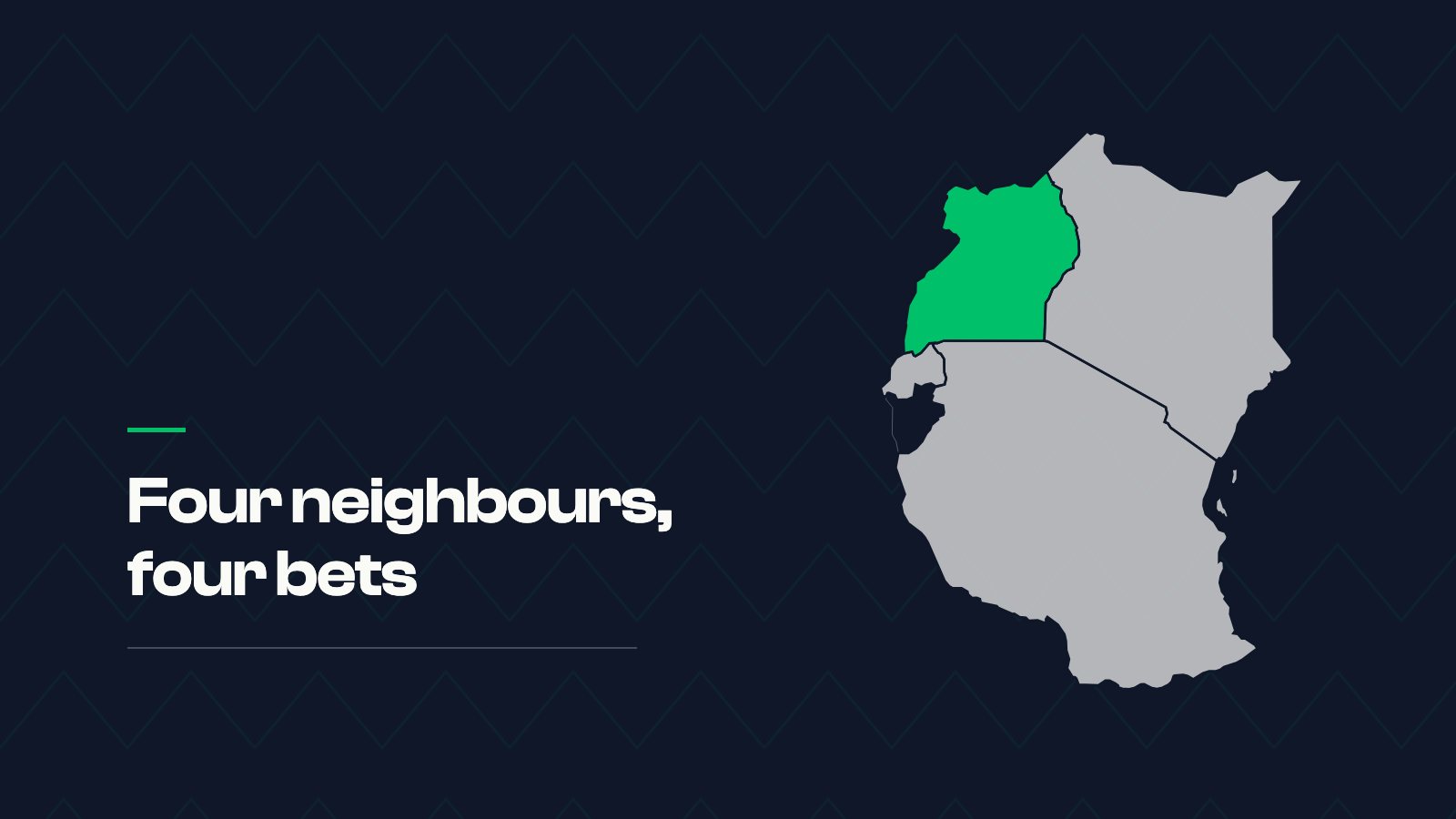
Graphic: Labwor Technologies
Same region, different wagers
From a desk in Kampala it is tempting to treat East Africa as one market with one story. It is not. Over roughly two decades, four countries with comparable income levels and overlapping languages have made noticeably different bets about where digital effort should go, and those bets have produced different strengths and different blind spots.
I have built software for Ugandan clients and deployed clinical systems for facilities in Uganda, Burundi and Botswana, and what strikes me most is how rarely we look sideways. Ugandan teams benchmark themselves against San Francisco or Bangalore, which is flattering and mostly useless. The instructive comparisons are next door, where the constraints are actually ours: the same power supply, the same procurement culture, the same customers counting out a data bundle.
What follows is a comparison on four things that matter to anybody building here: payment rails, identity, government platforms and the money available to startups. I have used figures from central banks and regulators where I could find them, and named the source in each case, because the numbers in this area are frequently repeated without one.
One caution before the numbers. Cross-country comparison in this region is harder than it looks, because each regulator counts differently and publishes on its own schedule. A transaction value in one country includes airtime purchases and in another does not. An account counted as active in one report has a different definition of active in the next. So I am reading these figures for direction and order of magnitude rather than for a league table, and I would encourage anybody citing them onward to do the same.

One anchor figure per country, each taken from that country’s own regulator or ministry.
Kenya: depth in the rails, and a gravity well for capital
Kenya’s bet was payments, made early and pushed hard, and the compounding is visible. The Central Bank of Kenya reported that mobile money agents in the country handled transactions worth KES 8.7 trillion in 2024, up 9.4 per cent on the KES 7.95 trillion recorded in 2023, with subscriptions rising from 77.3 million to 84.6 million and active agents from 322,404 to 381,116.
What matters is less the headline value than what got built on top of it. Because a reliable payment layer already existed, a generation of Kenyan companies could assume it rather than construct it, and that assumption is a large part of why capital goes there. Figures compiled by Africa: The Big Deal put Kenyan startups at 984 million US dollars raised in 2025, close to a third of everything raised across the continent that year, ahead of Egypt at 614 million, South Africa at 600 million and Nigeria at 343 million. The same source shows how quickly that ordering can move: in the first half of 2026 Egypt led with 327 million, Nigeria took 254 million, Kenya 126 million and South Africa 83 million.
Uganda does not appear in those tables in any meaningful way, and the absence is the finding rather than an oversight. Capital follows infrastructure, and it follows other capital. Nairobi has both, and a founder in Kampala is competing against that fact whether or not their product is better.

Central Nairobi. Photo: Michael Njoroge, Unsplash.
Kenya’s government platform, eCitizen, is the other half of the story and it carries a warning Uganda should read closely. The state has onboarded services onto it at an extraordinary rate, into the tens of thousands. But a special audit by Kenya’s Office of the Auditor-General, reported in 2025, flagged weak internal controls, the absence of a proper legal framework, heavy dependence on the original vendor, and overcharging of citizens amounting to roughly KES 2.6 billion. Counting services onboarded is not the same as counting services used, and a platform can generate an impressive dashboard while a citizen still queues.
Tanzania: interoperability as a default
Tanzania is the country East African commentary most consistently underrates. The Bank of Tanzania’s National Payment Systems Annual Report for 2025 records mobile payment values rising 28.3 per cent to TZS 255.1 trillion, volumes up 24.1 per cent to just under 8 billion transactions, and 76.5 million active mobile money accounts by December 2025.
The interesting part is structural rather than numerical. Tanzania moved early on letting money pass between different mobile money providers instead of trapping customers inside a single network. Anybody who has built a payment integration knows exactly what that changes. When a customer can pay from whichever wallet they happen to hold, you write one flow rather than negotiating separately with every operator in the market, and a small business stops needing an account with each of them.
On identity, Tanzania’s National Identification Authority reports more than 22.6 million people now holding national identification numbers, and the country is consolidating towards a single identifier rather than the sprawl of separate institutional IDs that most of the region still lives with. That consolidation is the part worth copying. Every extra registry a government maintains is another place a citizen has to prove who they are, and another integration a developer has to build before their product can do anything useful.
Rwanda: the state behaving like a product team
Rwanda’s bet was the smallest in absolute terms and the most disciplined in execution. Its government services portal, Irembo, now carries in the region of 240 public services according to the Ministry of ICT and Innovation in 2025, with more than 400,000 personal accounts opened as of March that year and over 3,000 agents helping citizens who cannot complete an application alone.
That last detail is the one I keep returning to. An agent network for government services is an open admission that not every citizen will self-serve online, and building for that reality instead of pretending it away is a decision most e-government projects refuse to make. It is the same insight that made mobile money work: the agent absorbs the part the technology cannot do. Rwanda’s National Identification Agency began enrolling residents onto a single digital identity in 2025, with roughly 1.5 million enrolled by early 2026 and a stated intention to retire the physical card by mid-2027. Whether that deadline holds is beside the point. The point is that a deadline exists in public and officials are held to it.
The obvious objection to Rwanda is fair: coordination is easier with fewer people and fewer districts. But the transferable lesson is not about scale. It is about sequencing one identity layer first and letting services depend on it, rather than allowing every ministry to build its own registry and then spending a decade reconciling them.
Uganda: strong rules, thin usage
Uganda’s position is genuinely odd, and you only see it by holding two sets of numbers next to each other.
On money, Uganda is doing well. The Bank of Uganda reported electronic money transaction values growing 28.6 per cent, from UGX 253.7 trillion in the twelve months to June 2024 to UGX 326.3 trillion in the year to June 2025, with volumes rising from 7 billion to 8.4 billion transactions and the agent network expanding from 775,294 to over a million. The Uganda Communications Commission puts mobile subscriptions at 61.6 million in the first quarter of 2026 and active mobile money accounts at 36.3 million as of December 2025.
On regulation, Uganda scores better than most of the continent. The ITU’s April 2025 report on digital development in Africa notes that only 18 per cent of African countries have reached the most advanced tier of ICT regulatory maturity, against a global average of 38 per cent, and lists Uganda among the small group that has, alongside Rwanda, Kenya, Nigeria, South Africa and a few others.
And yet in that same report’s comparison of internet use across countries, drawn on 2023 figures, Uganda sits among the three lowest in the region. The UCC counted about 18.5 million internet subscriptions in December 2025 in a country of well over forty million people, with roughly 19 million smartphones as of September 2025.
So Uganda has good rules, a strong payments layer, and comparatively weak use of the internet itself. The bottleneck is not policy and it is not payments. It is the price of data, the price of a device, and the shortage of things online that are worth paying for in Luganda or Acholi rather than in English.
What travels, and in which direction
Three borrowings seem obvious to me, in order of how quickly they could be done.

Three borrowings in, and the one asset Uganda has to lend. Regulatory figure: ITU, April 2025.
From Tanzania, interoperability as a baseline expectation rather than a commercial favour. Every hour a Ugandan developer spends writing separate integrations for separate wallets is an hour not spent on the product, and that tax is ultimately paid by every small business in the country whether they know it or not.
From Rwanda, one identity layer that other systems can lean on, with a published date attached to it. Ugandan systems currently each solve identity from scratch. In cooperatives, in schools, in clinics, I have watched the same verification problem be rebuilt over and over because there was nothing dependable underneath it.
From Kenya, both lessons at once. Kenya proves that a deep payments layer attracts capital. Its Auditor-General proves that a register of digitised services can be largely dormant while everyone celebrates. If Uganda builds a citizen platform, the metric worth publishing is completed transactions by real people, not services onboarded.
The traffic is not one way either. Uganda’s regulatory maturity is real and the ITU’s own figures say so. An agent network past a million is an enormous distribution asset that almost nobody is building products against. And Uganda’s language landscape, usually described as an obstacle, is the reason the most interesting African language technology I know of is being built here rather than in a larger market.
The four countries are not running the same race at different speeds. Kenya bought depth, Tanzania bought reach, Rwanda bought coordination, and Uganda bought rules it has not yet cashed in. If I had to name the cheapest useful thing Uganda could do next, it would not be a new platform or a new policy. It would be making time online worth the money it costs, because 86 per cent of the continent lives under a mobile broadband signal while only 38 per cent of it uses the internet, and no amount of good regulation closes that gap by itself.
Sources and further reading
- Annual Report 2025
- 2025 funding review and H1 2026 update
- Special audit of the eCitizen platform
- National Payment Systems Annual Report 2025
- Uganda's electronic money transactions grow by 28.6% in 12 months to UGX 326.3 trillion
- Mobile subscriptions and mobile money data
- State of digital development and trends in the Africa region
Frequently asked questions
How does Uganda's mobile money and internet use compare to Kenya, Tanzania and Rwanda?
Each country made a different bet. Kenya went deepest on payments and now attracts the most startup capital in the region. Tanzania let money move between different mobile money providers instead of trapping customers in one network. Rwanda built a smaller but disciplined government services portal with published deadlines. Uganda has strong financial regulation and a payments layer past a million agents, but comparatively weak internet use, so its bottleneck is the cost of data and devices, not policy.
What can Uganda learn from how Kenya, Tanzania and Rwanda built their digital government platforms?
Three lessons stand out. From Tanzania, treat interoperability between payment providers as a baseline rather than a favour, so businesses are not rebuilding the same integration for every wallet. From Rwanda, build one identity layer other government systems can depend on, with a public deadline attached. From Kenya's own Auditor-General, measure a government platform by completed transactions by real people, not by how many services have simply been onboarded.
Why does Uganda have strong financial regulation but comparatively low internet use?
Because good regulation and affordable data are two different problems. The ITU's April 2025 report places Uganda among the small group of African countries with the most advanced telecom regulation, yet on 2023 internet-use figures Uganda sits among the three lowest in the region. The bottleneck is the price of data and devices, and the shortage of things online worth paying for in Luganda or Acholi rather than English.